When deliberation meets reality
A response to ARIA’s Collective Flourishing opportunity space and Part 1 of the Critical thinking infrastructure essay series.
Abstract
Researchers have studied collective decision-making methods for decades, from multi-criteria analysis to deliberative democracy platforms. Under real operational pressure people almost always drop them in favour of gut feel and spreadsheets. The field has plenty of methods. What it lacks is an explanation for why analytically superior methods fail when the stakes are real. Speed binds decision quality more tightly than rigour does: the constraint is the time it takes to ask a question and get a defensible answer. The missing precondition for collective flourishing is critical thinking infrastructure that runs fast enough to survive contact with reality and leaves a trace the collective can inspect.
Hypotheses introduced (one per section):
- Decision quality tracks the number of question-answer iterations behind it. Many ordinary answers in sequence beat one brilliant answer in isolation.
- The methods exist and have been studied for fifty years. What needs explaining is why people drop them when stakes get real.
- Speed binds decision quality more tightly than rigour does.
- People prefer simple stories because simple stories are quick to produce and pass on. That is rational under time pressure.
- When decisions reshape the landscape, a slow decision answers the wrong question. The world it describes is gone.
- Coordination without enforcement loses to adversaries who can ask questions faster than the group can answer them.
- Progress in collective reasoning comes from question-answer iteration. The faster the cycle, the more value accumulates.
- Fast decisions made through inspectable tools leave a trail the collective can learn from. Gut-instinct decisions leave nothing.
Introduction
ARIA’s Collective Flourishing programme, led by Dr Nicole Wheeler, asks a good question: what if we could build tools that let societies move from reactively correcting the past to consciously creating the future? The opportunity space document names a real problem, that our tools for navigating complexity have not kept pace with the world, and proposes “deliberative scaffolding” as the solution: tools and protocols that help societies see, reason, and choose together.
I agree with the diagnosis. As a first draft I think two things are under-weighted: decision speed (chronically underestimated) and the viability of collective deliberation under real-world pressure (often overestimated). And the scientific question that sits under both: why are analytically superior methods abandoned when they matter most? In fairness, this is hard to study. It has to be tested in high-pressure environments with real stakes, which does not lend itself to controlled experiments. What follows is a constructive critique, developed alongside my own work on spatial knowledge graphs and AI-augmented decision support for supply chain systems.
The core argument: the missing precondition for collective flourishing is critical thinking infrastructure that runs fast enough to survive contact with reality. Question-answer tools that compress months of analysis into minutes, get sharper with each cycle, and leave a trace the collective can inspect, challenge, and use to hold decision-makers accountable.
How decisions actually work
Hypothesis: decision quality tracks the number of question-answer iterations behind it. Many ordinary answers in sequence beat one brilliant answer in isolation.
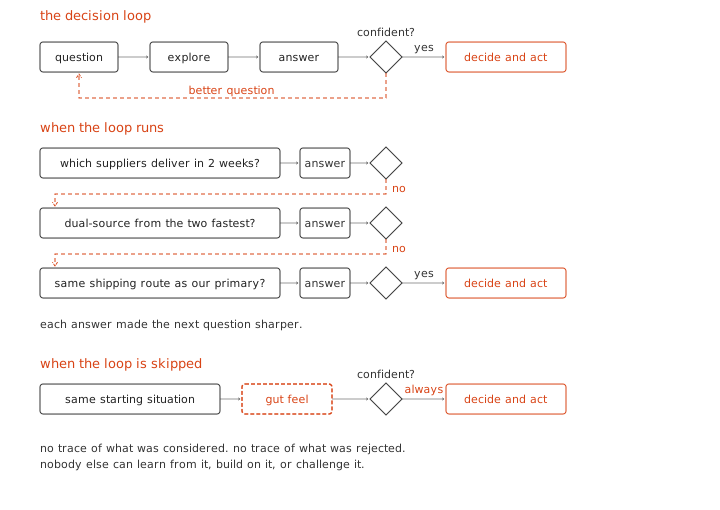
Every decision requires action, but before acting there are questions. We have a hypothesis about how something works or what might happen. We explore, talk, gather data, get answers. If we are confident in the answers, we decide and act. If not, we refine the hypothesis and go again. This is the scientific method, simplified.
Good answers open better questions. A manufacturer asking “which suppliers can deliver within two weeks?” gets an answer, and that answer leads to “what if we dual-source from the two fastest?” which leads to “is the cheaper option dependent on the same shipping route as our primary?” Each question is sharper than the last, and each only exists because the previous one was answered. The quality of the final decision tracks the number of these iterations, not the brilliance of any single answer.
Now replace that cycle with gut feel. An experienced executive walks into a room, sizes up the situation, and decides from gut. The business does well, but research suggests this is mostly luck1. The executive gets the credit anyway. And the process leaves nothing behind: no trace of what was considered, what was rejected, what assumptions were tested. Nobody else can learn from it or challenge it, and when the call was wrong, nobody can reconstruct why.
This matters when the stakes are high. Bad decisions on infrastructure placement waste millions. Bad decisions on supply chains during a crisis cascade through thousands of businesses. Bad decisions on climate policy affect billions. The difference between good and bad decisions at scale is whether the question-answer cycle ran properly or got skipped.
Part 1: why current approaches fail under pressure
The field has plenty of methods. The question is why none of them survive pressure.
Hypothesis: the methods exist and have been studied for fifty years. What needs explaining is why people drop them when stakes get real.
ARIA requires that an opportunity space be “under-explored relative to its potential impact.” Collective decision-making has been studied for decades. Multi-criteria decision analysis. Problem structuring methods. Delphi. Scenario planning. Deliberative democracy platforms. The toolkit is large and mature. The academic literature on wicked problems goes back to Rittel and Webber in 19732. Polis, cited in Wheeler’s own bibliography, has been running since 2014 and was deployed in Taiwan’s vTaiwan process in 2015. Fuzzy cognitive maps date to the 1980s.
These methods work in idealised, low-pressure environments. The moment things get critical, people revert to gut feel and spreadsheets. Klein’s research on naturalistic decision-making confirmed this across firefighters, military commanders, and ICU nurses: experts under pressure do not compare options analytically; they recognise patterns and satisfice3. During Hurricane Katrina, FEMA’s centralised planning could not figure out how to move supplies into New Orleans. Walmart, using decentralised decisions and the same logistics it runs every day, had trucks of water and food past the roadblocks two days before the government showed up. The CEO’s instruction was simple: make the best decision you can with the information available4.
The under-explored question is scientific: why are analytically superior methods abandoned when they matter most?
The speed contradiction
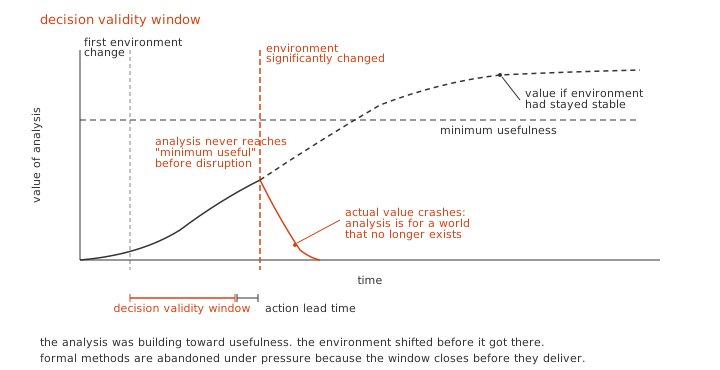
Hypothesis: speed binds decision quality more tightly than rigour does.
Wheeler’s document talks about helping societies “see, reason, and choose together.” “Together” implies consensus processes, and consensus is slow by design. Democracy is slow by design. Multi-criteria deliberation is slow by design. And the same document describes a world becoming more volatile, with rising risk of polycrises.
These two claims are in tension.
Under crisis conditions, the neurological switch from System 2 (analytical) to System 1 (intuitive) processing is a biological constraint. Yu’s SIDI model in Neurobiology of Stress (2016) provides the evidence: stress forces diminished prefrontal executive control and exaggerated subcortical reactive activity5. Deliberative scaffolding does not change the neuroscience. The only intervention that works is compressing analytical reasoning to fit inside the decision window.
Wheeler’s own framing hints at this, asking how we can coordinate actors to act “quickly and with an awareness of possible outcomes.” The word “quickly” is doing a lot of work there, and the opportunity space would benefit from giving it more room.
Simple stories win because they are fast, not because people are stupid
Hypothesis: people prefer simple stories because simple stories are quick to produce and pass on. That is rational under time pressure.
The document observes that “complexity and uncertainty are uncomfortable, so we favour simple stories and confident answers, even when they are wrong.” This is presented as a cognitive bias to overcome.
I think the framing is wrong. Simple stories and confident answers are quick. The preference for simple stories is probably a rational adaptation to time pressure. Complex stories take too long to construct and communicate. Gigerenzer’s research on heuristic decision-making supports this: in many real-world conditions, ignoring part of the information leads to more accurate judgments than weighting and integrating everything6.
If that is true, the solution changes. You do not teach people to tolerate complexity. You make complex answers as fast to access as simple ones.
In landscape-altering environments, slow decisions become wrong decisions
Hypothesis: when decisions reshape the landscape, a slow decision answers the wrong question. The world it describes is gone.
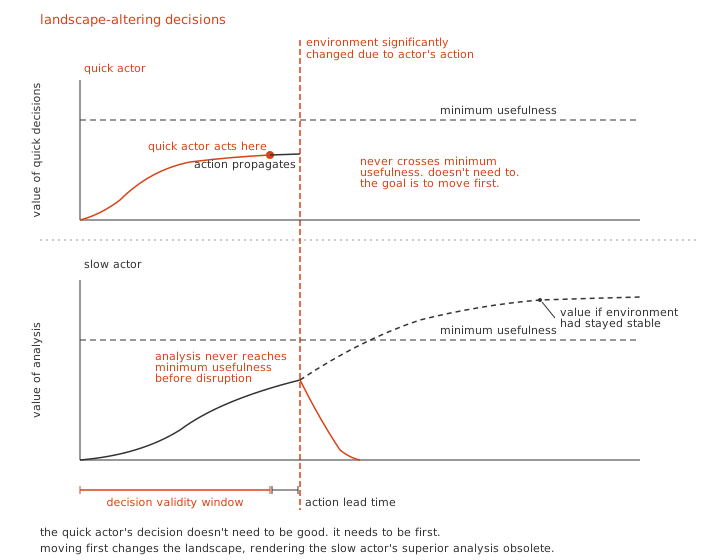
In any environment where decisions alter the decision landscape, the value of a decision decays over time. A perfect decision made after the landscape has shifted is worse than a good-enough decision made while the landscape still matches the one you analysed. Slow deliberation produces analyses of a world that no longer exists.
Boyd understood this in military contexts. The OODA loop works because your decision changes your opponent’s landscape and forces them to re-orient. The actor with the faster loop makes the slower actor’s in-progress analysis obsolete7. Boyd was talking about adversarial dyads. In multi-stakeholder systems like supply chains, climate policy, and urban planning, everyone’s decisions are simultaneously changing everyone else’s landscape.
This gives rise to a decision validity window: the time during which an analysis of the current landscape stays accurate enough to act on. In stable environments (academic research, infrastructure planning, constitutional design), this window is months or years, and deliberation works. In volatile, coupled environments (supply chain crises, competitive markets, geopolitical shocks), it is hours or days, and deliberation cannot fit. Eisenhardt’s study of strategic decision-making in high-velocity industries found that fast decision-makers use more information, not less, and that speed and quality are not a trade-off: fast decisions led to better performance8.
C-level executives are, by selection, critical thinkers. They are trained in structured analysis, they have access to sophisticated tools, and they face decisions with enormous consequences. Yet under time pressure, whether a competitive public tender, a supply chain disruption, or a market shift, they fall back on gut. Sometimes they excel at it. The environment does not allow the time critical thinking requires.
There is also a competition for attention. In practice, a gut-feel answer and an analytical answer are racing for the same decision-maker. A quick answer that leads to a follow-up question outsprints a slow analytical answer. By the time the analytical answer arrives, the situation has moved on, and decision-makers are reluctant to reverse course and start over. The analytical method loses the room before it produces an answer.
Collective progress is vulnerable to sabotage, and climate proves it
Hypothesis: coordination without enforcement loses to adversaries who can ask questions faster than the group can answer them.
The opportunity space frames collective flourishing in terms of shared progress and coordinated action. Game theory tells us that any coordination mechanism without enforcement is vulnerable to defection. Olson’s Logic of Collective Action established this formally: groups fail to coordinate for collective benefit even when it is in everyone’s interest, because individual incentives favour free-riding9. In supply chains, information sharing is the known solution to the bullwhip effect, and firms systematically refuse to do it because sharing erodes competitive advantage10. The EU Corporate Sustainability Due Diligence Directive is literally a regulatory attempt to force the coordination that the market will not produce voluntarily11.
But the sabotage problem goes deeper than defection. It is a problem of tempo.
Climate policy looks like a counter-example to the speed thesis. It runs on multi-decade time horizons where slow deliberation should be appropriate. Consider the record. Climate is one of the most heavily analysed and modelled collective challenges we have, and it has produced insufficient action. The modelling, policy analysis, consensus, frameworks, and legislation will one day be useful for understanding why we failed to act. That is the problem: it is not leading to action.
The primary mechanism is tempo asymmetry. Asking a question is cheap and fast: a press release, a funded study, a lobbying position. Answering it rigorously is expensive and slow: data collection, modelling, peer review, policy analysis. Adversaries exploit this. They do not need better answers; they just need to produce more questions than the system can answer. Every unanswered question becomes justification for delay. “We need more research before we act” is the most effective obstruction strategy ever deployed, because it sounds like a call for rigour.
And divide-and-conquer layers on top. Once delay is established, you fragment the coalition. You do not attack the science; you attack the solution. Carbon tax versus cap-and-trade. Renewables versus nuclear. Mitigation versus adaptation. Each disagreement is genuine and worth debating, but the debate multiplies the questions, each demanding its own slow analysis cycle.
Climate is the strongest supporting case for the speed thesis. The long time horizon enabled more effective adversarial delay, not better deliberation.
The intervention follows directly: compress time-to-answer so that questions cannot be used as delay tactics. You cannot stall a process that answers questions faster than you can ask them.
Part 2: what would actually work
The missing iteration loop
Hypothesis: progress in collective reasoning comes from question-answer iteration. The faster the cycle, the more value accumulates.
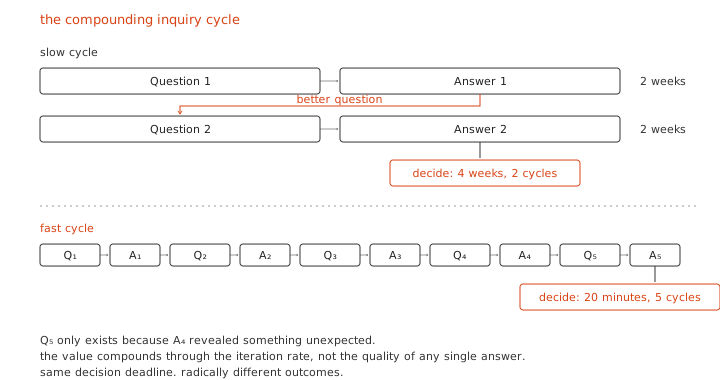
There is a pattern in the scientific method that the opportunity space does not address: the inquiry cycle that builds on itself. More questions lead to more answers, which lead to better questions, which lead to better answers. The value sits in the iteration rate12.
Reading the ARIA document carefully, the framing is single-turn. It treats the six themes (organising knowledge, evidence synthesis, value elicitation, wargaming, decision-making under uncertainty, cognitive autonomy) as independent capabilities. The document never identifies the cycle between them, or the value that builds up when iteration is fast, as the thing that needs to be accelerated.
When time-to-answer is large, all the energy goes into finding answers, with almost none left for finding questions. The questions are where the value lives. Answers are the mechanism by which you earn the right to ask a better question12. When time-to-answer collapses, you get different, better questions that you would never have thought to ask, because the previous answer revealed something unexpected.
This is the scientific method. Hypothesis, experiment, observation, revised hypothesis, better experiment. Breakthroughs come from environments that compress the experimental cycle: Faraday’s bench experiments, Edison’s Menlo Park, modern high-throughput drug screening. The scientific revolution was the formalisation of rapid, iterative empiricism.
Any system for collective flourishing that does not explicitly design for rapid cycling between understanding and action will produce the same single-turn outputs that have failed for decades.
The bridge: fast grounded decisions enable collective learning; gut instinct does not
Hypothesis: fast decisions made through inspectable tools leave a trail the collective can learn from. Gut-instinct decisions leave nothing.
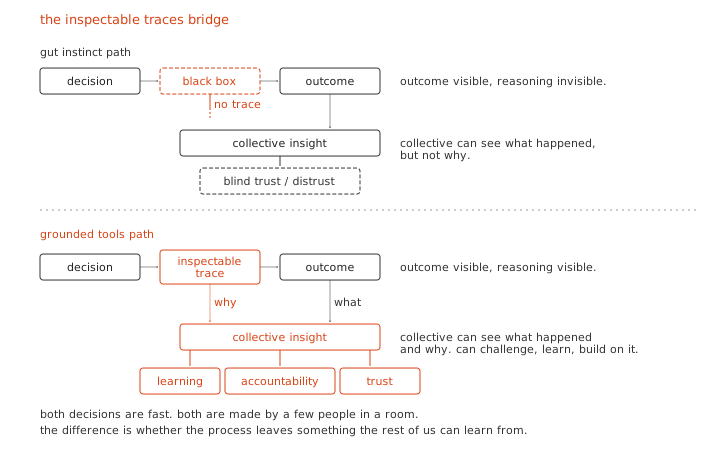
Everything above reads like an argument against collective flourishing: fast decisions by a few, slow deliberation irrelevant, sabotage inevitable. That conclusion only holds if fast decisions are opaque. And gut-instinct decisions are opaque by definition.
Nobody, not the decision-maker, not their organisation, not the affected public, can reconstruct why a gut-instinct choice was made. “I had a feeling” is not inspectable. “The spreadsheet said so” is barely better. The assumptions are buried, the alternatives unexplored, the reasoning invisible. The collective is locked out because the decision process left no trace.
It is also a lose-lose for the decision-makers. Many situations require quick decisions by a few key people, and those people can and should be held accountable by the collective. But right now they cannot rely on anything beyond gut, and when they are wrong they cannot defend the call. The ones who thrive are the ones who happen to be right, which over time becomes a game of chance. Or the ones who claim they are always right, despite evidence to the contrary. Inspectable tools cut both ways: the collective needs them for accountability, and the decision-makers need them for defensibility.
Now consider the alternative. Decisions made through structured tools that operate on knowledge graphs, with minimised time-to-question and time-to-answer. The decision itself is still fast, minutes rather than weeks. It may still be made by a few people in a room. But the process leaves a complete, inspectable trace: the question asked, the data queried, the scenarios compared, the trade-offs evaluated, the alternatives considered and rejected. Every step is grounded in queryable evidence, not narrative.
That trace becomes the substrate for collective understanding. After the fast decision, the collective can inspect the reasoning. They can ask: why was option B rejected? What assumptions drove the scenario comparison? What would have changed if we weighted environmental impact more heavily? These are queries against the same evidence infrastructure that supported the original decision. The collective is not second-guessing in the dark. They are engaging with the actual reasoning, grounded in the actual evidence.
This also addresses the sabotage problem. Opaque decisions by powerful actors are unaccountable by nature. Decisions made through inspectable, grounded tools are accountable by construction. A corporation that claims “we had no alternative” can be challenged with the same evidence that shows what alternatives existed.
Wheeler’s vision of collective flourishing, societies that see, reason, and choose together, does not require that every decision be made collectively in real time. It requires that decisions, however fast and however narrow the decision-making group, produce reasoning that the collective can inspect, learn from, and use to hold decision-makers accountable.
The missing precondition
The under-explored gap is why people drop analytically superior methods when those methods matter most. The answer is the decision speed gap: any tool slower than the decision cycle gets bypassed.
The missing precondition for collective flourishing is critical thinking infrastructure: systems that make it cheap and fast to question assumptions, test claims against structured evidence, and explore counterfactual futures. Tools that help people think harder without making them slower.
Understanding that arrives after the action window has closed is no use. The challenge is fitting rigorous, iterative reasoning into the window that is actually available, and doing it in a way that leaves a trace the rest of us can learn from.
Wheeler’s deliberative scaffolding vision is incomplete. The scaffolding needs a foundation, and that foundation is the ability to reason rigorously inside real decision windows.
Fitza, M.A. (2014) ‘The use of variance decomposition in the investigation of CEO effects: how large must the CEO effect be to rule out chance?’, Strategic Management Journal, 35(12), pp. 1839–1852. Available at: https://doi.org/10.1002/smj.2192. Note: Quigley, T.J. and Graffin, S.D. (2017) ‘Reaffirming the CEO effect is significant and much larger than chance: a comment on Fitza (2014)’, Strategic Management Journal, 38(3), pp. 793–801, available at https://doi.org/10.1002/smj.2503, offered a rebuttal arguing the effect is significant; Fitza, M.A. (2017) ‘How much do CEOs really matter? Reaffirming that the CEO effect is mostly due to chance’, Strategic Management Journal, 38(3), pp. 802–811, available at https://doi.org/10.1002/smj.2597, responded with a counter-rebuttal. The debate continues, but both sides agree that industry and macroeconomic factors explain the majority of variance in firm performance. See also Keller, T., Glaum, M., Bausch, A. and Bunz, T. (2023) ‘The “CEO in context” technique revisited: a replication and extension of Hambrick and Quigley (2014)’, Strategic Management Journal, 44(4), pp. 1111–1138. Available at: https://doi.org/10.1002/smj.3469. ↩︎
Rittel, H.W.J. and Webber, M.M. (1973) ‘Dilemmas in a general theory of planning’, Policy Sciences, 4(2), pp. 155–169. Available at: https://doi.org/10.1007/BF01405730. Note: For a 52-year retrospective confirming the enduring influence of the framework, see Peters, B.G., Head, B.W., Danaeefard, H. and Khosravi, M. (2026) ‘What do we know about wicked problems after nearly 52 years? Tracing the DNA of wicked problems through a bibliometric study’, Administration & Society. Available at: https://doi.org/10.1177/00953997251415534. ↩︎
Klein, G. (1998) Sources of power: how people make decisions. Cambridge, MA: MIT Press. Available at: https://mitpress.mit.edu/9780262611466/sources-of-power/ (Accessed: 7 April 2026). Note: See also Klein, G. (1993) ‘A recognition-primed decision (RPD) model of rapid decision making’, in Klein, G.A., Orasanu, J., Calderwood, R. and Zsambok, C.E. (eds) Decision making in action: models and methods. Norwood, NJ: Ablex Publishing, pp. 138–147. A 2023 systematic review of 32 empirical studies confirmed RPD in all studies that analysed decision-making strategy: Reale, C., Salwei, M.E., Militello, L.G., Weinger, M.B., Burden, A., Sushereba, C., Torsher, L.C., Andreae, M.H., Gaba, D.M., McIvor, W.R., Banerjee, A., Slagle, J. and Anders, S. (2023) ‘Decision-making during high-risk events: a systematic literature review’, Journal of Cognitive Engineering and Decision Making, 17(2), pp. 188–212. Available at: https://doi.org/10.1177/15553434221116822. ↩︎
Horwitz, S. (2009) ‘Wal-Mart to the rescue: private enterprise’s response to Hurricane Katrina’, The Independent Review, 13(4), pp. 511–528. Available at: https://www.independent.org/pdf/tir/tir_13_04_3_horwitz.pdf (Accessed: 7 April 2026). Note: For context on the broader theory–practice gap in humanitarian logistics, see Rodríguez-Espíndola, O., Ahmadi, H., Gastélum-Chavira, D., Ahumada-Valenzuela, O., Chowdhury, S., Dey, P.K. and Albores, P. (2023) ‘Humanitarian logistics optimization models: an investigation of decision-maker involvement and directions to promote implementation’, Socio-Economic Planning Sciences, 89, 101669. Available at: https://doi.org/10.1016/j.seps.2023.101669. ↩︎
Yu, R. (2016) ‘Stress potentiates decision biases: a stress induced deliberation-to-intuition (SIDI) model’, Neurobiology of Stress, 3, pp. 83–95. Available at: https://doi.org/10.1016/j.ynstr.2015.12.006. Note: The stress–decision link is confirmed across domains in Reale, C., Salwei, M.E., Militello, L.G., Weinger, M.B., Burden, A., Sushereba, C., Torsher, L.C., Andreae, M.H., Gaba, D.M., McIvor, W.R., Banerjee, A., Slagle, J. and Anders, S. (2023) ‘Decision-making during high-risk events: a systematic literature review’, Journal of Cognitive Engineering and Decision Making, 17(2), pp. 188–212. Available at: https://doi.org/10.1177/15553434221116822. ↩︎
Gigerenzer, G. and Gaissmaier, W. (2011) ‘Heuristic decision making’, Annual Review of Psychology, 62, pp. 451–482. Available at: https://doi.org/10.1146/annurev-psych-120709-145346. Note: Extended to organisational decision-making in Gigerenzer, G., Reb, J. and Luan, S. (2022) ‘Smart heuristics for individuals, teams, and organizations’, Annual Review of Organizational Psychology and Organizational Behavior, 9, pp. 171–198, available at https://doi.org/10.1146/annurev-orgpsych-012420-090506. See also Spiliopoulos, L. and Hertwig, R. (2024) ‘Stochastic heuristics for decisions under risk and uncertainty’, Frontiers in Psychology, 15, 1438581. Available at: https://doi.org/10.3389/fpsyg.2024.1438581. ↩︎
Boyd, J.R. (1987) A discourse on winning and losing. Unpublished briefing. Available at: https://www.colonelboyd.com/s/Discourse-on-Winning-and-Losing-Boyd.pdf (Accessed: 7 April 2026). Note: For a supply chain application of OODA-loop thinking, see the contrast between Walmart’s distributed rapid-response and FEMA’s centralised deliberation during Hurricane Katrina, documented in Horwitz, S. (2009) ‘Wal-Mart to the rescue: private enterprise’s response to Hurricane Katrina’, The Independent Review, 13(4), pp. 511–528. ↩︎
Eisenhardt, K.M. (1989) ‘Making fast strategic decisions in high-velocity environments’, Academy of Management Journal, 32(3), pp. 543–576. Available at: https://doi.org/10.5465/256434. Note: Tested across multiple industries and environmental contexts in Shepherd, N.G., Mooi, E.A., Elbanna, S. and Rudd, J.M. (2021) ‘Deciding fast: examining the relationship between strategic decision speed and decision quality across multiple environmental contexts’, European Management Review, 18(3), pp. 119–140. Available at: https://doi.org/10.1111/emre.12446. ↩︎
Olson, M. (1965) The logic of collective action: public goods and the theory of groups. Cambridge, MA: Harvard University Press. Available at: https://www.hup.harvard.edu/books/9780674537514 (Accessed: 7 April 2026). Note: The 2007 Nobel Prize in Economics to Hurwicz, Maskin and Myerson for mechanism design theory confirms the centrality of Olson’s collective action problem: the field exists because voluntary coordination systematically fails. ↩︎
Lee, H.L., Padmanabhan, V. and Whang, S. (1997) ‘The bullwhip effect in supply chains’, Sloan Management Review, 38(3), pp. 93–102. Available at: https://sloanreview.mit.edu/article/the-bullwhip-effect-in-supply-chains/ (Accessed: 7 April 2026). Note: Bullwhip dynamics were observed at global scale during COVID-19. For recent work on how supply chain networks transmit systemic financial risk, see Fialkowski, J., Diem, C., Borsos, A. and Thurner, S. (2025) ‘A data-driven econo-financial stress-testing framework to estimate the effect of supply chain networks on financial systemic risk’, arXiv preprint, arXiv:2502.17044. Available at: https://arxiv.org/abs/2502.17044. ↩︎
European Parliament and Council of the European Union (2024) Directive (EU) 2024/1760 of the European Parliament and of the Council of 13 June 2024 on corporate sustainability due diligence and amending Directive (EU) 2019/1937 and Regulation (EU) 2023/2859. Brussels: Official Journal of the European Union. Available at: https://eur-lex.europa.eu/eli/dir/2024/1760/oj (Accessed: 7 April 2026). Note: Provides for fines of up to 5% of worldwide turnover for non-compliance with supply chain due diligence obligations. The existence of this legislation is itself evidence that voluntary collective coordination failed, consistent with Olson (1965). ↩︎
Girba, T. and Wardley, S. (n.d.) On rewilding software engineering. The question-answer iteration concept draws on their observation that when time-to-answer is large, organisational energy is consumed by finding answers rather than finding questions, and that the questions are where the value compounds. See, e.g., Girba, T. (2024) ‘Rewilding software engineering’, feenk blog. Available at: https://blog.feenk.com/ (Accessed: 7 April 2026). ↩︎ ↩︎