I’m Elias, a technical entrepreneur based in London. I spent over 15 years doing deep research on how things move through cities (waste trucks, recycling, logistics), including a PhD on the algorithms, and turned most of it into VC-backed products. Eventually, I realised the interesting problem is the reasoning that happens before anyone moves anything. So now I build spatial knowledge graphs and AI tools for supply chains, compressing months of analysis into minutes. The deeper question is how groups make better decisions when the world moves faster than their tools. The goal is, once again, products. A sensible career progression, if you squint.
Apr. 9, 2026
This is a series of essays on building infrastructure for better decision-making. The end-goal is to allow decision makers dealing with high-pressure and time-sensitive problems, to ask and get defensible answers in minutes, instead of weeks and months.
The immediate context is logistics and supply chain planning, though the ideas reach further. The argument is that the bottleneck in most high-stakes decisions is not the absence of data or models but the absence of infrastructure for asking good questions quickly. The essays cover shortcomings in existing decision models, the technical architecture of a solution, AI, and the human layer.
Apr. 8, 2026
A technical accompaniment to the Deliberation Meets Reality series, in which we analyse and position the platform as a commercially viable and venture backed initiative.
Abstract
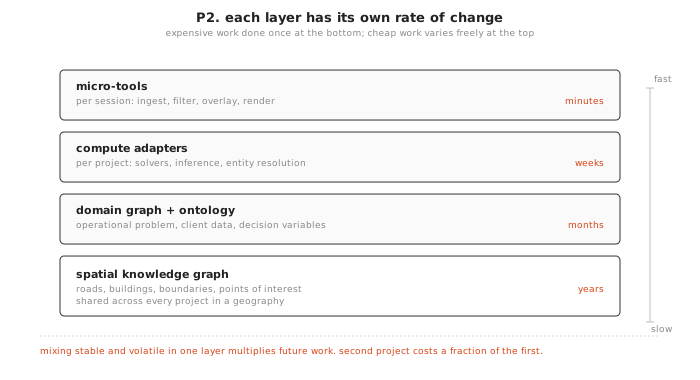
The same architecture mapped from a venture-backed company perspective rather than a public infrastructure one. The exercise identifies where value is evolving on the stack, why the substrate layer (the graph engine, the domain ontology framework, the rehydration contracts) is underfunded relative to where capital will flow next, and which components should be open-sourced to accelerate the commodity tier rather than defended as proprietary. It names the moat, the build-buy-consume decisions that fall out of the geometry rather than out of preference, and the specific events that would force a revision of the map. Written as a technical piece in which the map does most of the argumentative work.
Apr. 5, 2026
A technical accompaniment to the Deliberation Meets Reality series, in which we analyse and position the platform as a UK-public good initiative.
Abstract
A Wardley mapping exercise that positions the fifteen components of the platform on the evolution axis from genesis to commodity, and reads the resulting landscape for a UK public infrastructure play. The map’s load-bearing commodity anchor is the UK public data commons (Ordnance Survey, ONS, Land Registry, Companies House, NUAR, and the FAIR data work of the Geospatial Commission), and its deliberate inertia sits on the Rust graph engine, which is held in place because the architectural principles it enforces are antibodies against failure modes observed repeatedly in production logistics systems. The post names the three climatic forces acting on the landscape, the seven strategic plays available in response, and the events that would force a revision of the map. The argument: grounded, inspectable decision support for physical operations is an under-provided public good, and the UK has the public data and academic open-source anchors to build it without importing a commercial stack.